
Somebody used to do this for a living
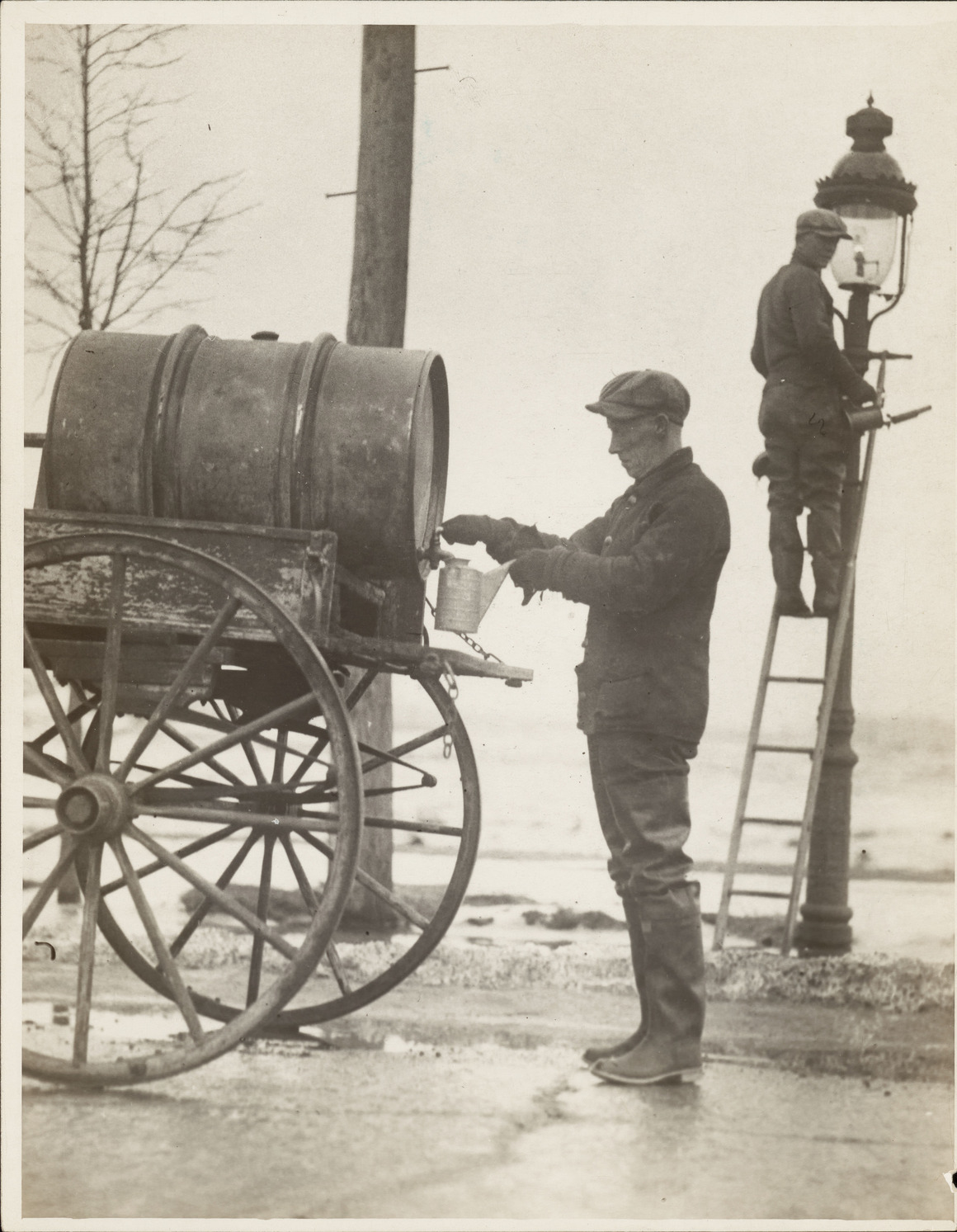
It's one of the most common consolations in modern work. The form is annoying, the portal is awkward, the spreadsheet has to be cleaned up, but once upon a time there was a clerk for that.
Clerk is the word in the research I've been reading. It's not a word I've ever heard anybody in Britain use about themselves, unless they work for a court or a parish council. I'm looking at you, Jackie Weaver.
The strange thing is that clerical work didn't disappear. In May 2023, office and administrative support was still the largest occupational group in the United States, with 18.5 million jobs. Nobody abolished administration. What changed is harder to see.
I should say plainly where I'm standing. My company puts reporting and data processes onto phones and dashboards. We spend a lot of time trying to remove paper, duplicated entry and the little manual steps that accumulate around a process. We're one of the mechanisms of digitisation, so this isn't an argument from the cheap seats.
And one of the things we still receive, surprisingly often, is a photograph of a form.
Or a letter. Or a handwritten note. Someone has taken a piece of paper, photographed it and attached the image to a digital report.
Somebody still has to read it, work out what matters, decide what it means, classify it, connect it to the right record and perhaps type part of it into another system.
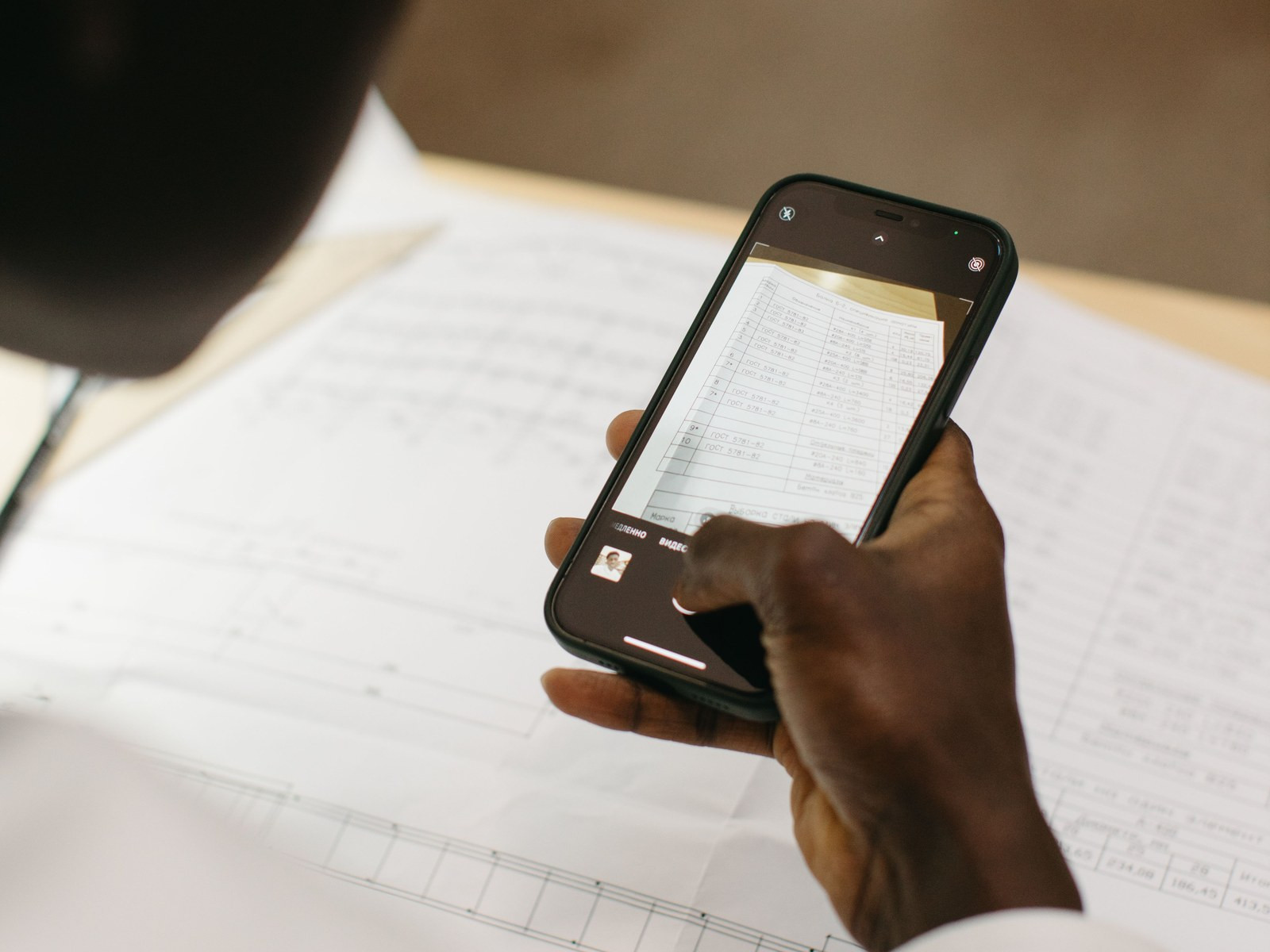
Not a scan. A photograph.
Held flat with a thumb.
Taken on a phone, in whatever light there was.
The report files correctly. Nothing breaks.
Then somebody has to read it.
The paper has become digital.The work has not.
That distinction turns out to have a literature behind it. Researchers Lise Justesen and Ursula Plesner have a wonderfully unglamorous name for the work that appears around digital systems: invisible digi-work. They divide it into three kinds. Compensating work. Connecting work. Cleaning work.
That may be the most useful description of modern administration I've come across.
The machine does its job. Then somebody compensates for what it missed, connects it to something it cannot reach, or cleans what it produced.
The system does the task. Somebody still does the work that has gathered around it.
Counted, costed, in the business case
Counted by nobody
Compensating
Doing by hand what the system missed.
Connecting
Joining it to something the system cannot reach.
Cleaning
Tidying what it produced before anybody can use it.
The remainder belongs to no one, sits in no plan and has never been counted.
Compensating, connecting, cleaning. The strange thing is that we once had a single word for somebody who did all three, and an official description of what it involved.
In 1959 the United States Bureau of Labor Statistics described what a secretary did. They handled "many business details for their employers on their own initiative", it said, "such as acknowledging correspondence, scheduling appointments and meetings, and obtaining a variety of information". Many "serve as representatives of their employers". The ones who were promoted were "given authority for making certain decisions".
In 2026 the same agency describes the same occupation as doing "routine clerical and organizational tasks".
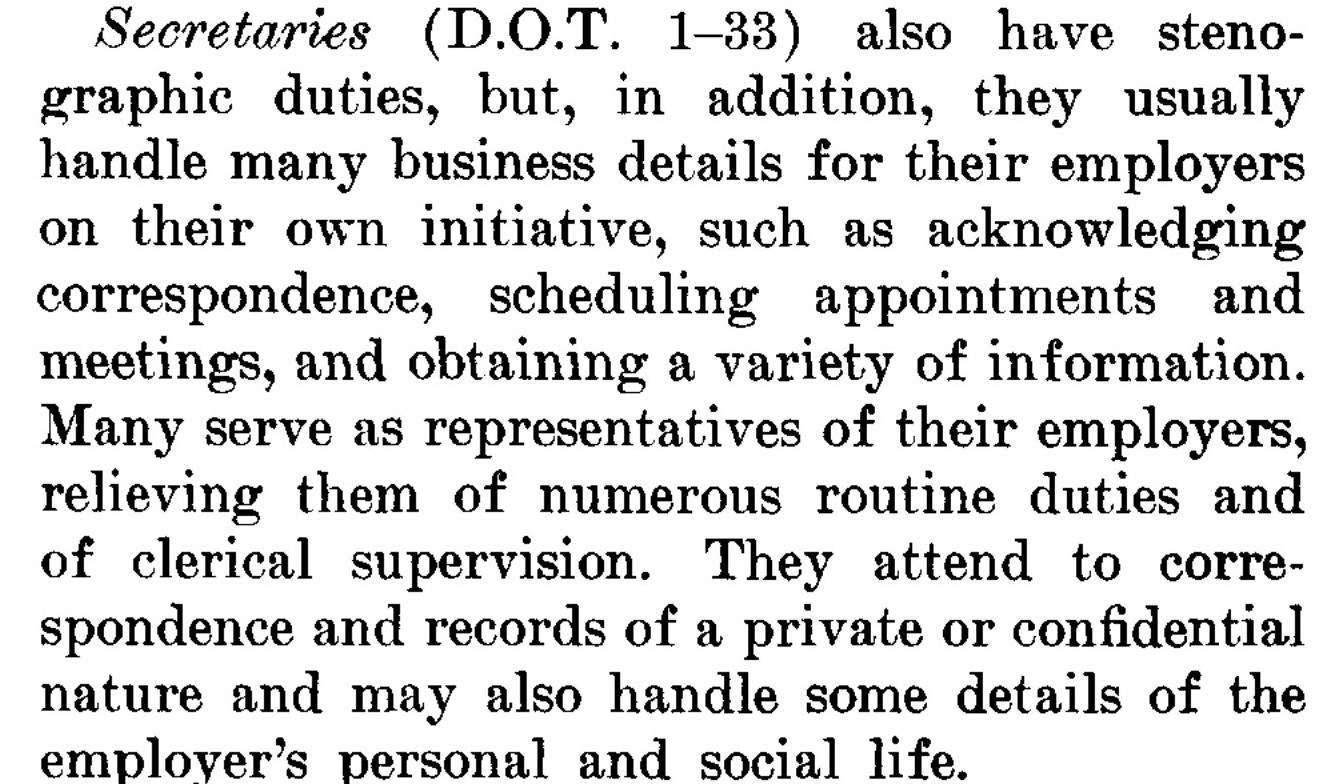
Transcription of the scan. Secretaries, D.O.T. 1-33, also have stenographic duties, but, in addition, they usually handle many business details for their employers on their own initiative, such as acknowledging correspondence, scheduling appointments and meetings, and obtaining a variety of information. Many serve as representatives of their employers, relieving them of numerous routine duties and of clerical supervision. They attend to correspondence and records of a private or confidential nature and may also handle some details of the employer’s personal and social life.
The judgement didn't go anywhere. It was written out of the description.
This isn't new. In a House of Lords debate in 1953, peers were discussing research showing how much of a ward sister's day had been swallowed by organisation and clerical work. The complaint was that the ward sister was becoming "so little of a nurse and so much of a clerk". The proposed answer was familiar too: employ clerical or secretarial support to take forms and telephone calls away from trained nurses.
Thirty years later, the human-factors researcher Lisanne Bainbridge described one reason why. Automation does not simply remove work. It changes the collection of tasks left to the human. The designer automates what can be specified and leaves the operator with what could not be designed away.

Nothing in that sequence looks like a job.
That's partly the problem.
The organisation can count its administration.
The person on the other side often cannot.
That remainder can be small enough to disappear from the business case and large enough to fill somebody's afternoon.
More recent research makes the point less theoretical. A 2024 study of digital public administration in Germany found what its authors called "work for digitalisation": scanning, IT support, software maintenance and data validation. Less complex tasks were partly substituted, but new compensating, connecting and cleaning work appeared around them. The researchers found the workload could increase rather than simply evaporate.
There's an even stranger version when the work crosses the boundary of the organisation.

Summary of the three figures below, all from the same study: documentation fell by 16 minutes per eight scheduled patient hours, after-hours electronic record work did not fall, and visits rose by about half a visit a week.
The time did not come back to the clinician. It came back to the clinic.
Source: JAMA, April 2026. A study of 8,581 clinicians across five academic medical centres. Read the source
Summary: teachers reported an average working week of 54.4 hours in 2016 and 48.1 hours in 2024, and three in four still say they spend too much time on general administration.
54.4 hours a week in 2016. 48.1 hours in 2024.
And three in four still say they spend too much time on general administration.
Measured hours fell. The feeling did not.
Source: Department for Education, Working Lives of Teachers and Leaders, sample of 10,020. Read the source
Self-service can be genuine automation. It can also be what researchers studying self-checkout have called pseudo-automation: the task is not performed by a machine at all. It is performed by the customer, unpaid.
You have probably done a version of this yourself. An organisation sends you a document. Later, another part of the same organisation asks you to upload a copy. You photograph the letter on the kitchen table, crop it, find the upload page and discover the file is too large.
Nothing in that sequence looks like a job. That's partly the problem.
The National Audit Office found something similar at a much larger scale when it examined the UK tax system. Between 2019-20 and 2023-24, HMRC's own cost of administering the tax system rose 15% in real terms. The NAO also found increasing administrative burdens on taxpayers despite the availability of digital channels, and noted that while HMRC estimates the cost to businesses, there is no equivalent estimate for individuals.
The organisation can count its administration. The person on the other side often cannot.
None of this means technology has failed. Quite the opposite. The useful warning is that successful automation can make the remaining work harder to notice.
The newest tools are already showing the same pattern. A Danish study linking surveys of roughly 25,000 workers to administrative labour-market records found widespread adoption of AI chatbots and reported productivity benefits, but no measurable effect on earnings or recorded hours large enough to exceed 2% two years after ChatGPT's launch. What did change was the structure of work, including new tasks around AI oversight and integration.
In medicine, a 2026 study of 8,581 clinicians across five academic medical centres found that AI scribes were associated with 16 fewer minutes of documentation per eight scheduled patient hours. That's real time. But after-hours electronic-record work did not significantly change, and clinicians delivered about half an additional visit a week. The saved time did not necessarily become empty time.
And the hours are not all rising. English teachers worked 48.1 hours a week in 2024 against 54.4 in 2016, and the fall came almost entirely out of the part that was not teaching. Roughly three quarters of them still say they spend too much time on general administration.
That's why I no longer think the useful question is simply, "What can we automate?"
What work will this remove? And what work will be left behind, moved somewhere else, or created around the edges?
The second question is the one most business cases are bad at.
It's also why the photograph of the form bothers me. Not because paper is old-fashioned. Sometimes taking a photograph is exactly the quickest and most sensible thing for the person standing there to do.
It bothers me because it's easy to count the digital submission and call the process digitised while ignoring everything somebody still has to do with the picture afterwards.
Ask what people are putting together by hand to keep somebody else informed. Ask what gets copied between systems. Ask what gets cleaned on Friday so the dashboard works on Monday. Ask what customers now type that an employee used to type. Ask what happens when the one person who quietly knows the workaround goes on holiday.
You will find administration in places where nobody has an administrative job title.
And sometimes you will find that the thing described as automated is simply a very efficient way of moving the work to somebody you stopped counting.
Somebody used to do this for a living.
Quite often, somebody still does.
We just stopped calling it their job.
Sources and notes
In the order they appear in the article.
- The 1959 description of a secretary. Occupational Outlook Handbook, 1959, page 235. United States Bureau of Labor Statistics. HathiTrust
- The current description of the same occupation. Occupational Outlook Handbook, current edition (2025 to 2035 projections), secretaries and administrative assistants. United States Bureau of Labor Statistics. Wording confirmed against the live page, 19 September 2026. BLS
- Automating the easy part leaves the operator the harder remainder. Lisanne Bainbridge, “Ironies of Automation”. Automatica, volume 19, number 6, 1983, pages 775 to 779. Paper
- The Danish study of chatbot adoption. Anders Humlum and Emilie Vestergaard, “Large Language Models, Small Labor Market Effects”. Working paper, 2025. Paper
- What administration costs, and what can be counted. National Audit Office, The administrative cost of the tax system, HC 675, February 2025. National Audit Office
- The ambient documentation trial. JAMA, April 2026. 8,581 clinicians across five academic medical centres. DOI 10.1001/jama.2026.2253. Study
- Teachers’ hours. Working Lives of Teachers and Leaders, Department for Education, 2024. Based on 10,020 responses. Department for Education
- The 1953 line about the ward sister. House of Lords, 12 May 1953. Hansard Two checks returned different peers, so the article names no speaker.
Make every report count.
Tell us what your team reports and we will show you how it works in Logincident.
Contact us